

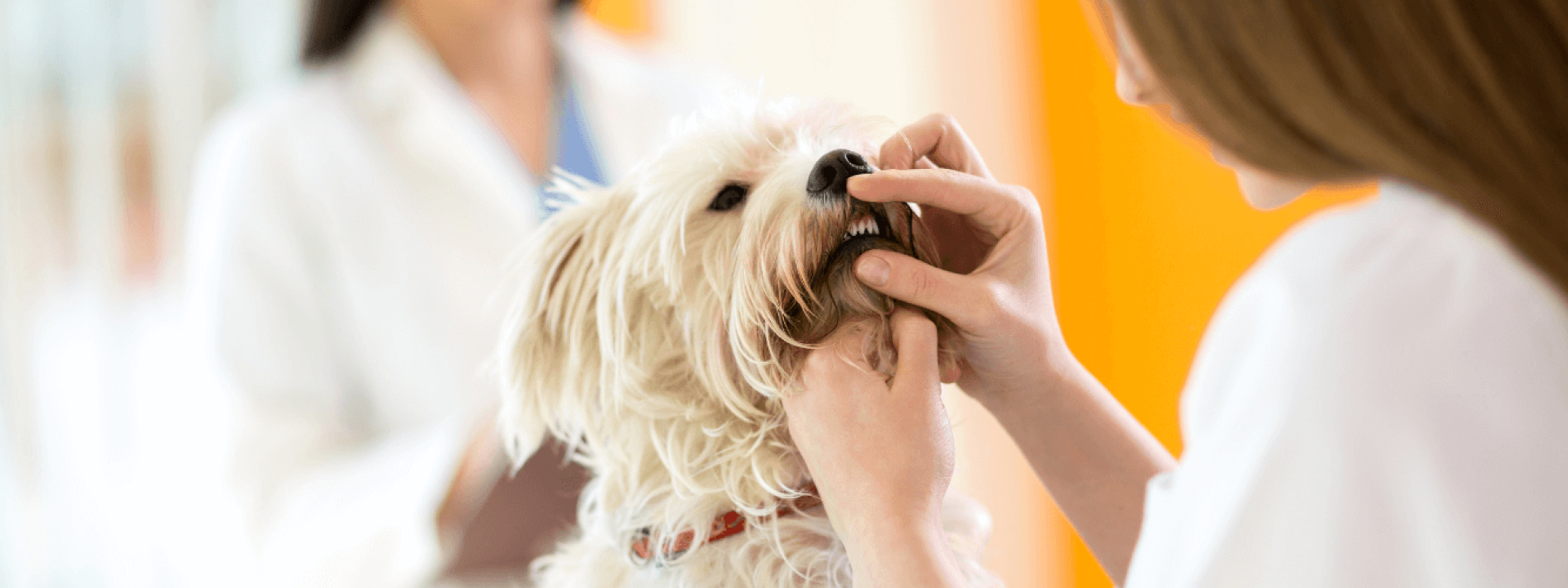
Many clients come to our veterinary clinics, heads held low, as they are embarrassed about their dog’s dental care. Look, we’re veterinarians—not robots! We understand that taking care of your dog’s dental care isn’t always a priority, and life happens. However, we’re also here to tell you that waiting because you’re embarrassed can only cause more harm. It’s best to get your dog’s dental care under control sooner rather than later to avoid a painful mouth and possibly big vet bills down the line if the dental disease gets too far advanced.
It’s also important to note that your dog’s dental health affects their overall health, just like humans. And even if you’re caring for your dog’s teeth at home as best you can; veterinary dental care for your dog is a must. Wondering how that all works? We share some FAQs about dog dental care and their answers below, so you realize not only the importance but the relative ease involved in professional dental care.
Does my dog need to get dental care from a veterinarian, or can I handle it at home?
Yes, to both! Veterinarians can perform dental therapy under anesthesia for your pet, but we like our clients to perform routine oral care at home. This includes daily tooth brushing and offering Veterinary Oral Health Council (VOHC)-recommended oral products.
What happens during a dental appointment?
A dental appointment involves assessing the degree of dental disease by visual inspection. We check for gingivitis, accumulation of tartar, oral masses, and odor.
Why do dogs need to be anesthetized for veterinary dental care?
Dogs need to be under general anesthesia since proper dental scaling is uncomfortable (think of your own experience when you see your dentist). Scaling under the gumline is a vital part of veterinary dental care, but it also causes discomfort. Dental radiographs are another important part of dental therapy, and dogs need to be completely relaxed to position the sensor in the mouth. We use ultrasonic scaling that produces water, and we pass a cuffed endotracheal (breathing) tube to protect your dog’s airway.
Will someone monitor my dog while under anesthesia?
Yes! At most if not all hospitals, a licensed veterinary technician is constantly monitoring your dog’s vital parameters during the dental procedure. We monitor heart rate, respiratory rate, pulse quality, oxygen saturation, carbon dioxide levels, and electrocardiogram (EKG).
What are some signs that my dog has dental issues?
Dogs rarely have changes in their food intake due to dental disease, so you cannot rely on their appetite as a sentinel for dental disease.
You may be able to visualize or notice some of the following symptoms of dog dental disease:
- Bleeding or inflamed gums
- Tartar accumulation
- Bad breath
- Loose teeth
- Problems picking up food
- Lumps or bumps in the mouth
- Bleeding onto dog toys
- Vocalizing while eating
Keep in mind that dogs can be very stoic about their pain, which is yet another reason regular dog dental visits are so vital.
Should my dog have dental wellness appointments or just go if or when they have dental issues?
During an annual exam, we check oral health as well. However, if you notice something concerning, please schedule a dental appointment. As with any health issues, the prognosis will always be better if we catch a problem sooner rather than later.
Gingivitis, periodontitis, and fractured teeth are common problems in adult dogs. We often see malalignment and retained baby teeth in young puppies.
Will my dog be given pain medications during and after dental therapy?
Yes! Medications for pain control are given before anesthesia is induced. If a patient requires extractions, we also administer local anesthetic blocks, and your pet will go home with post-operative pain medications.
The American Animal Hospital Association (AAHA) shared the following 10 facts you need to know to protect your pet’s oral health:
1. Dental disease begins early in life.
2. Dental disease causes significant, chronic pain in pets.
3. X-rays are essential for diagnosing dental disease.
4. Anesthesia makes dental evaluation and treatment safer and less stressful for your pet.
5. Anesthesia is much safer than you may think.
6. Nonanesthetic dentistry is stressful, unsafe, and ineffective.
7. Removing plaque from teeth beneath the gum line is vital.
8. Your veterinarian may create a personalized pain protocol to keep your pet comfortable.
9. Homecare is an essential part of taking care of your pet’s oral health.
10. Not all pet dental products are created equal.
Visit that link to get a more detailed description of why those 10 facts are critical to dog dental care. What the AAHA and just about any veterinarian will try to impart to you as the dog owner is that, while tempting, dental care that doesn’t involve anesthesia won’t actually protect your dog against dental disease. However, if you’re still concerned or have any other questions, please don’t hesitate to give us a call!
Book Pet Appointment
Review Us!
Orchard Road Animal Hospital